
A roadmapping tool we actually wanted to use.
For years, our backlog, prioritization, capacity planning, and roadmap tools were scattered across 4 different platforms, and none of it ever stayed in sync. We kept our backlog in Jira, user research in Canny, prioritization in Google Sheets, and did capacity planning/roadmappin in a hacked together Asana. While our team is far from unique, the tools that we had at hand and on the market didn’t fit our process, which was a nightmare. So I learned to use Claude and built a fully fucntioning production level app in one week. It's now the tool that our entire Product, Design and Engineering team relies on.
Claude
AI
Roadmapping
Prioritization
Capacity Planning
Claude AI Roadmapping Prioritization Capacity Planning
Keywords
What it actually does
Prioritization that matches how our team thinks
We prioritize our backlog in Google Sheets using RICE, but unlike other teams, also look at RIC as well. We use an app called Canny to surface our biggest customer requests from Intercom as well, which is an important indicator for us. Instead of customer signal being a slide we'd point to once a quarter, we needed it to be a live input into what rises to the top. But Canny doesn’t integrate well with many platforms, and their prioritization features are weak.
We needed one place to view and prioritize everything together. No tool we tried did all of that for us, and the majority of tools that came somewhat close were extremely expensive and outside of our budget. I built a backlog that works exactly as we need, fully integrated with Canny (while surfacing only the important feedback).

A roadmap and quarterly planning that understands capacity
This is the part I couldn't find anywhere else, and the reason we'd been hacking Asana. Our new roadmap is built on top of our actual team allocation, so when we do planning, the tool understands who is needed from each team, for how long, and how much overlap between the phases (e.g. if we can we start development while design is ongoing, and how early). It understands who is booked (from Product, Design and Engineering) and for how long, and then shows us where our problem areas are. It takes into account team buffers, context switching, and dev skills). We can move things around and immediately see whether a sprint is overcommitted instead of finding out as it happens. No Product tools do this.
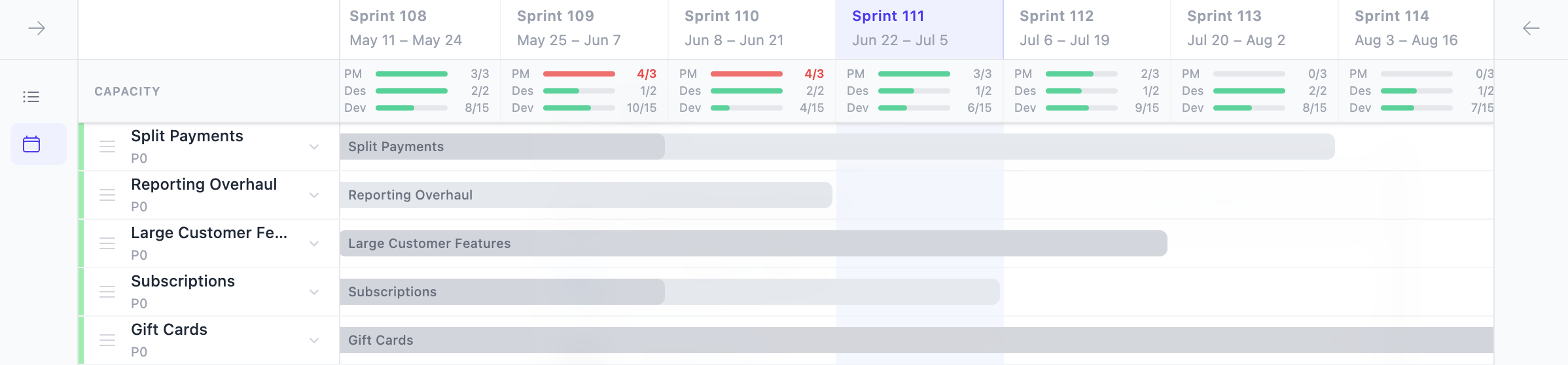
The backlog and the roadmap are one system
Because prioritization and planning live in the same place, the roadmap is just the prioritized backlog laid out over time. No more scoring in a spreadsheet, replanning in Asana, and rebuilding the roadmap by hand. What we decide to do shows up on the roadmap automatically, and what's on the roadmap traces straight back to why we picked it.
Real-time Jira status anyone can read
The platform integrates with Jira and pulls live project status, then shows it in a view built for everyone, not just engineers. Now anyone across the org can see exactly where a project stands without opening Jira or pinging a PM. There's only one roadmap now, and it's always up to date because it reads the real source of truth instead of being a snapshot someone has to remember to refresh.
the result
We retired the Google Sheets, the hacked-together Asana setup, and the second Jira roadmap, along with all the manual upkeep and copy-paste that held them together. Prioritization, roadmapping, and quarterly planning now happen in one place that's built around how our team actually works, with customer signal from Canny and live status from Jira both feeding in automatically.
There's a single roadmap now, it's always up to date, and anyone in the company can answer "what are we building and when" for themselves instead of tracking down a PM. Quarterly planning went from a guessing game to something grounded in our real capacity. And the whole thing was built from scratch in a week by someone using AI for the first time.